
Introduction
Many students get confused by British American English because both versions appear everywhere — in school, on YouTube, in books, in apps, and even on signs. The tricky part is that both versions can be correct, but they are used in different countries and contexts.
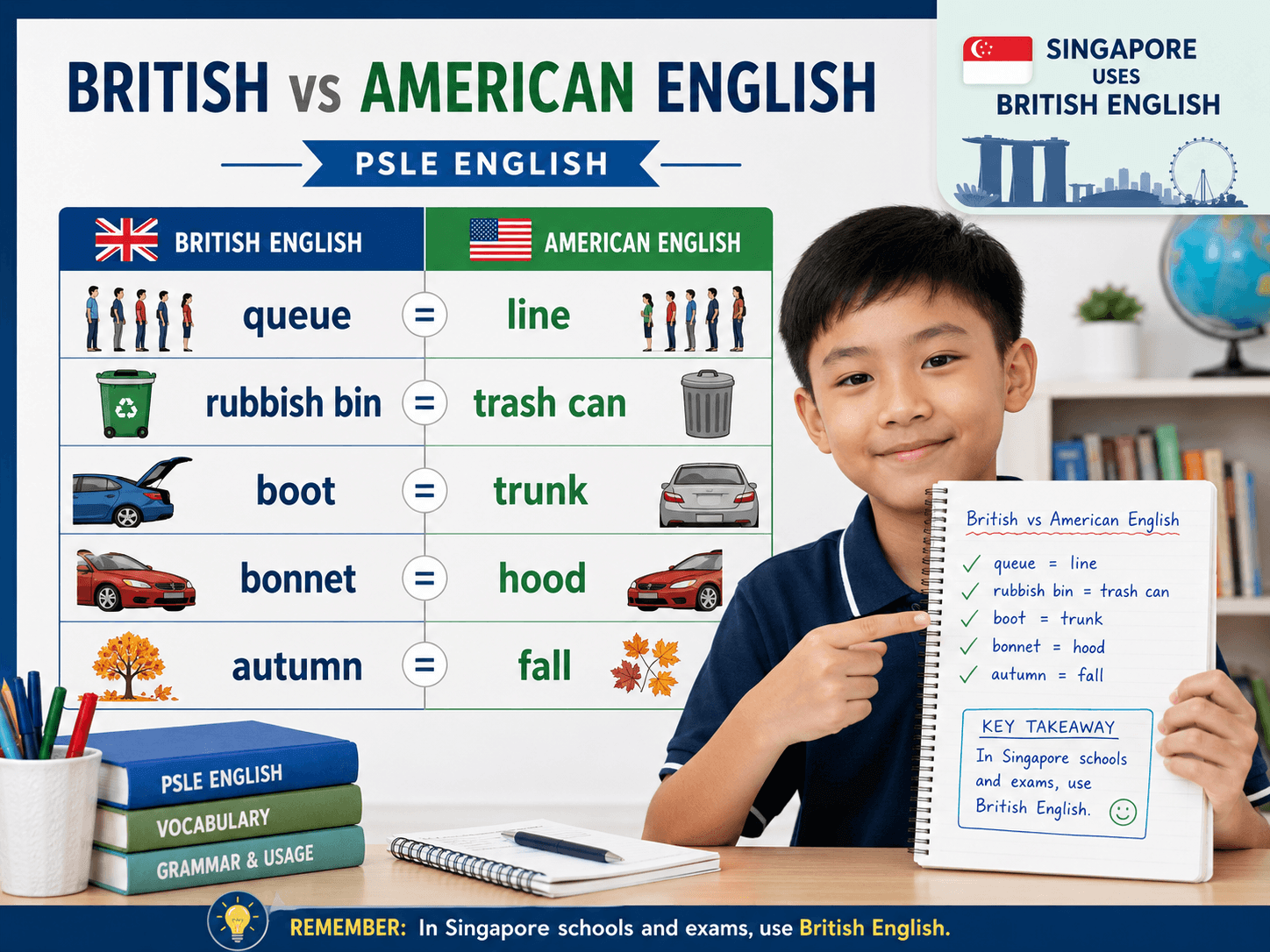
In Singapore, students usually follow British English for school writing and exams. This means words like queue, rubbish bin, boot, and bonnet are more commonly accepted in formal school contexts.
Understanding British American English helps PSLE English students write more consistently, avoid confusion, and choose the right word for the right situation.
The Question / Scenario Explanation
Source: British English vs American English, explained by Coach Thaheera
The screenshots show Coach Thaheera explaining common differences between British English and American English. The main message is that both versions can be understood, but in Singapore school writing, students should usually use the British English form.
Some examples from the video include:
- British English: queue | American English: line
- British English: rubbish bin | American English: trash can
- British English: boot | American English: trunk
- British English: bonnet | American English: hood
- British English: flat | American English: apartment
- British English: autumn | American English: fall
The key lesson is not that American English is wrong. Rather, students should know which version is more suitable for Singapore school contexts.
Step-by-Step Solution / Explanation
Step 1: Understand That Both Versions Can Be Correct
British English and American English are both valid forms of English. They simply use different words, spellings, and sometimes pronunciations.
For example, a person in the United Kingdom may say:
Please join the queue.
A person in the United States may say:
Please stand in line.
Both sentences can be understood. The difference is the English variety being used.
Step 2: Know What Singapore Usually Follows
Singapore generally follows British English in school and formal writing. That is why students often see British-style words and spellings in worksheets, textbooks, notices, and exam-style passages.
For PSLE English, students should usually choose the British English word if the context is school-based or formal.
For example:
- Please queue here.
- Do not throw rubbish on the floor.
- Put your luggage in the boot.
- Open the bonnet to check the engine.
Step 3: Compare “Queue” and “Line”
One common British American English difference is:
- British: queue
- American: line
In Singapore, signs often use phrases such as:
- Please queue here.
- Please stay in queue.
- Queue starts here.
So in a Singapore school context, queue is usually the better word to use.
Step 4: Compare “Rubbish Bin” and “Trash Can”
Another useful difference is:
- British: rubbish bin
- American: trash can
In Singapore, students are more likely to see and hear:
Please throw your rubbish into the rubbish bin.
The American version would be:
Please throw your trash into the trash can.
Both can be understood, but for Singapore school writing, rubbish and rubbish bin are usually more suitable.
Step 5: Compare “Boot” and “Trunk”
When talking about the storage space at the back of a car, British and American English use different words.
- British: boot
- American: trunk
British-style sentence:
I put my luggage in the boot of the car.
American-style sentence:
I put my luggage in the trunk of the car.
For Singapore school English, boot is usually the preferred form.
Step 6: Compare “Bonnet” and “Hood”
The front cover of a car engine also has different names.
- British: bonnet
- American: hood
British-style sentence:
Open the bonnet to check the engine.
American-style sentence:
Open the hood to check the engine.
Again, both are correct in the right context, but Singapore students should usually recognise and use the British form.
Step 7: Compare “Flat” and “Apartment”
Another common pair is:
- British: flat
- American: apartment
In Singapore, students may hear both, but British English traditionally uses flat. For example:
They live in a flat near the MRT station.
The American-style version would be:
They live in an apartment near the station.
Step 8: Compare “Autumn” and “Fall”
The season after summer is also named differently.
- British: autumn
- American: fall
For example:
The leaves turn brown in autumn.
In American English, someone may say:
The leaves turn brown in fall.
This is another useful British American English difference for students to recognise when reading passages or watching videos online.
Step 9: Keep Your English Consistent
The most important exam tip is consistency. Students should avoid mixing British and American English unnecessarily in the same piece of writing.
For example, this sentence sounds mixed:
I waited in line before throwing my rubbish into the trash can.
A more consistent British-style version would be:
I waited in the queue before throwing my rubbish into the rubbish bin.
This helps the writing sound cleaner and more suitable for Singapore school English.
Key Concepts Students Must Know
- British and American English are both correct: The difference is where and how they are used.
- Singapore usually follows British English: This is especially important for school writing and exams.
- Vocabulary can differ: For example, queue and line mean similar things but come from different English varieties.
- Context matters: American words may appear online, while British words are more common in Singapore school contexts.
- Consistency improves writing: Students should avoid mixing British and American terms in the same answer.
Exam Tips / Common Mistakes
Exam Tips
- Use British English vocabulary when writing for Singapore school assignments.
- Check whether the word you are using is British or American.
- Read the full sentence to decide which word fits the context.
- Keep the same English variety throughout your composition or answer.
- Be careful when learning from online videos, because many use American English.
Common Mistakes
- Thinking American English is always wrong.
- Thinking British English is always the only correct form everywhere.
- Mixing words like queue and line randomly in the same paragraph.
- Using American terms in formal Singapore school writing without realising it.
- Not recognising British-style words in comprehension passages.
A useful way to remember this topic is: both versions may be understood, but for Singapore school English, the British form is usually safer.
Parent Insight
Parents may notice that children pick up American English naturally from YouTube, Netflix, games, apps, and online worksheets. This is normal because American English is very common in digital content.
However, students still need to understand British English because Singapore schools usually expect it in formal writing. Instead of telling children that one version is “wrong”, it is better to explain that different English varieties are used in different places.
Parents can practise with quick comparison questions such as:
- Do we usually say queue or line in Singapore?
- Which one is more British: rubbish bin or trash can?
- Which word would you use in a school composition?
- Are you mixing British and American words in the same paragraph?
This helps students become more aware of language choices without feeling confused or discouraged.
Conclusion
British American English differences are common, and both versions can be correct depending on the context. However, for Singapore students, British English is usually the better choice in school writing.
Useful pairs to remember include:
- Queue instead of line
- Rubbish bin instead of trash can
- Boot instead of trunk
- Bonnet instead of hood
- Flat instead of apartment
- Autumn instead of fall
By understanding the difference and using language consistently, PSLE English students can write more accurately and confidently.
Visit our homepage: Click Here...
Read more on our blog: Click Here...
Start here (limited slots weekly):
Free Trial: Click Here...
Enroll: Click Here...
Explore our main tuition brand approach here: Click Here…