
Introduction
Should your child write learnt or learned? What about practice or practise? Understanding British English Singapore conventions can help students make more consistent spelling and word-choice decisions in school writing.
Singapore English generally follows British spelling conventions in formal education. However, students are also constantly exposed to American English through YouTube, social media, books, games and other online content. As a result, it is completely understandable for forms such as learned, burned or practice as a verb to look familiar.
In this lesson, we look at some useful British and American English differences and, more importantly, explain the distinction between practice and practise that PSLE English students should know.
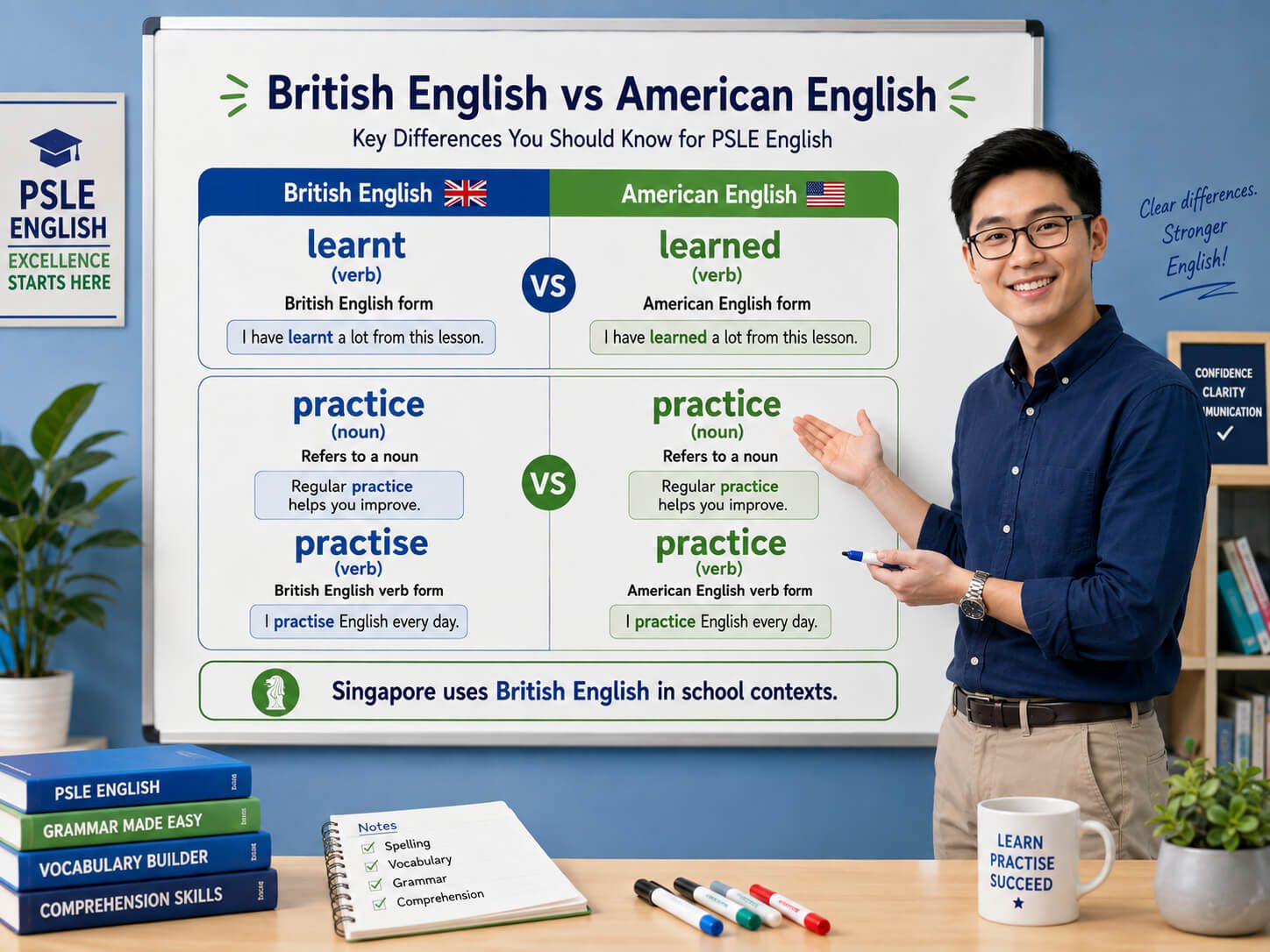
The Question / Scenario Explanation
Source: Singapore British vs American English doesn’t have to be confusing.
The video introduces several words that may appear differently in British and American English.
For example:
- learnt / learned
- spelt / spelled
- burnt / burned
- dreamt / dreamed
- practice / practise
One important point is that not every difference is a simple case of “British correct, American wrong”.
For verbs such as learn, both learnt and learned are used in British English, although learnt is particularly common in British usage. The same variation can occur with words such as burnt/burned and dreamt/dreamed.
The distinction between practice and practise, however, is especially useful for students because traditional British English uses them for different grammatical functions.
Step-by-Step Solution / Explanation
Step 1: Understand Why British and American English Differ
English is used in many countries, and spelling conventions have developed differently over time.
As a result, two words can have the same meaning while being written differently.
For example:
- British English: colour — American English: color
- British English: favourite — American English: favorite
- British English: organise — American English commonly uses organize
For school writing in Singapore, students will commonly encounter British conventions, so consistency is useful.
Step 2: Learnt or Learned?
Consider these sentences:
I learnt something new today.
I learned something new today.
Both forms can be grammatically correct.
Learnt is widely associated with British English, while learned is especially common in American English and is also used in British English.
For students who want to keep their writing consistently British in style, learnt is a useful form to recognise and use.
For example:
Correct:
Sarah learnt an important lesson from the experience.
Also grammatically accepted:
Sarah learned an important lesson from the experience.
Step 3: Look at Similar -t and -ed Forms
The same pattern appears in several other verbs.
British-associated forms:
- learnt
- dreamt
- spelt
- burnt
Common American-associated forms:
- learned
- dreamed
- spelled
- burned
Students should not assume that every -ed version is automatically incorrect in British English. Several of these forms coexist.
The more useful exam habit is to recognise the convention your school uses and remain consistent in formal writing.
Step 4: Practice or Practise?
This pair follows a more specific rule in traditional British English.
Practice with a c is the noun.
Example:
Regular practice will improve her writing.
Here, practice refers to the activity or process itself.
Practise with an s is the verb.
Example:
She should practise her writing every day.
Here, practise describes the action being performed.
Step 5: Use the Noun-or-Verb Test
When students are unsure whether to write practice or practise, ask:
Is this word naming something, or is someone doing something?
If it names an activity or session, use the noun:
practice
Example:
Football practice starts at 4 p.m.
If it describes an action, use the verb:
practise
Example:
The team will practise after school.
Step 6: Remember the Advice–Advise Pattern
Students who struggle with practice/practise can connect it to another familiar British English pair:
advice = noun
advise = verb
For example:
My teacher gave me useful advice.
My teacher advised me to read more.
This can help students remember:
practice = noun
practise = verb
Step 7: Know the American English Difference
In American English, practice is generally used for both the noun and the verb.
For example:
Noun: I need more practice.
Verb: I practice every day.
In traditional British English:
Noun: I need more practice.
Verb: I practise every day.
For students following British English Singapore conventions, remembering this noun-versus-verb distinction is useful.
Key Concepts Students Must Know
- Singapore school English generally follows British conventions: Students should become familiar with British spelling patterns.
- Learnt and learned can both occur: Learnt is strongly associated with British English, while learned is particularly common in American usage and is also accepted in British English.
- Practice is a noun in traditional British English: Example: “She needs more practice.”
- Practise is a verb in traditional British English: Example: “She should practise daily.”
- American English usually uses practice for both: This is why students may see “practice” used as a verb online.
- Consistency matters: Avoid switching unnecessarily between different spelling conventions within the same piece of formal writing.
Exam Tips / Common Mistakes
Exam Tips
- For practice/practise, identify whether the word is functioning as a noun or verb.
- Use the advice/advise pattern to remember the difference.
- Keep your spelling convention consistent throughout a composition.
- Build a personal list of common British and American spelling differences.
- During proofreading, check frequently confused words separately from grammar and punctuation.
Common Mistakes
- Assuming learned is always wrong in British English: It is not. Both learnt and learned are used.
- Using practice as the verb in British-style school writing: Traditional British usage distinguishes practice as the noun and practise as the verb.
- Choosing based only on pronunciation: Practice and practise sound the same, so students must look at their grammatical function.
- Mixing spelling systems randomly: For example, using “colour” in one paragraph but “favorite” in another may make the writing inconsistent.
- Memorising without context: Students remember these words more reliably when they practise them in complete sentences.
Parent Insight
Children in Singapore are exposed to both British and American English every day. They may encounter British spelling in school but American spelling in videos, apps, games and online articles.
Seeing both versions does not necessarily mean your child has misunderstood English. Often, they are simply encountering different legitimate conventions.
A useful approach is to teach children to recognise the difference and then maintain the convention expected in their school writing.
For practice and practise, parents can turn revision into a quick grammar game. Read a sentence aloud and ask, “Is this naming the activity, or describing an action?” If it is an action, the child should recognise that the British verb is practise.
Conclusion
Understanding British English Singapore conventions becomes easier once students separate genuine spelling differences from grammatical differences.
Learnt is commonly associated with British usage, although learned is also accepted. However, practice and practise have distinct roles in traditional British English:
Practice = noun
Practise = verb
Students do not need to feel confused whenever they encounter an American spelling online. Instead, they should understand why the variation exists and learn which convention to use consistently in school.
Visit our PSLE English homepage: Explore MasterEnglish
Read more PSLE English guides: Visit Our English Blog
Start here (limited slots weekly):
Free Trial: Click Here…
Enroll: Click Here…
Explore our main tuition brand approach here: Click Here…