
Introduction
Their, there, they’re sound exactly the same when spoken, but they have completely different meanings. This makes them one of the most common spelling and grammar mix-ups for English students.
The good news is that students do not need to memorise complicated rules. Each word has a simple job: their shows possession, there refers to a place or introduces something, and they’re is short for they are.
For PSLE English students, learning to distinguish their there they’re can improve accuracy in compositions, editing questions and everyday writing.
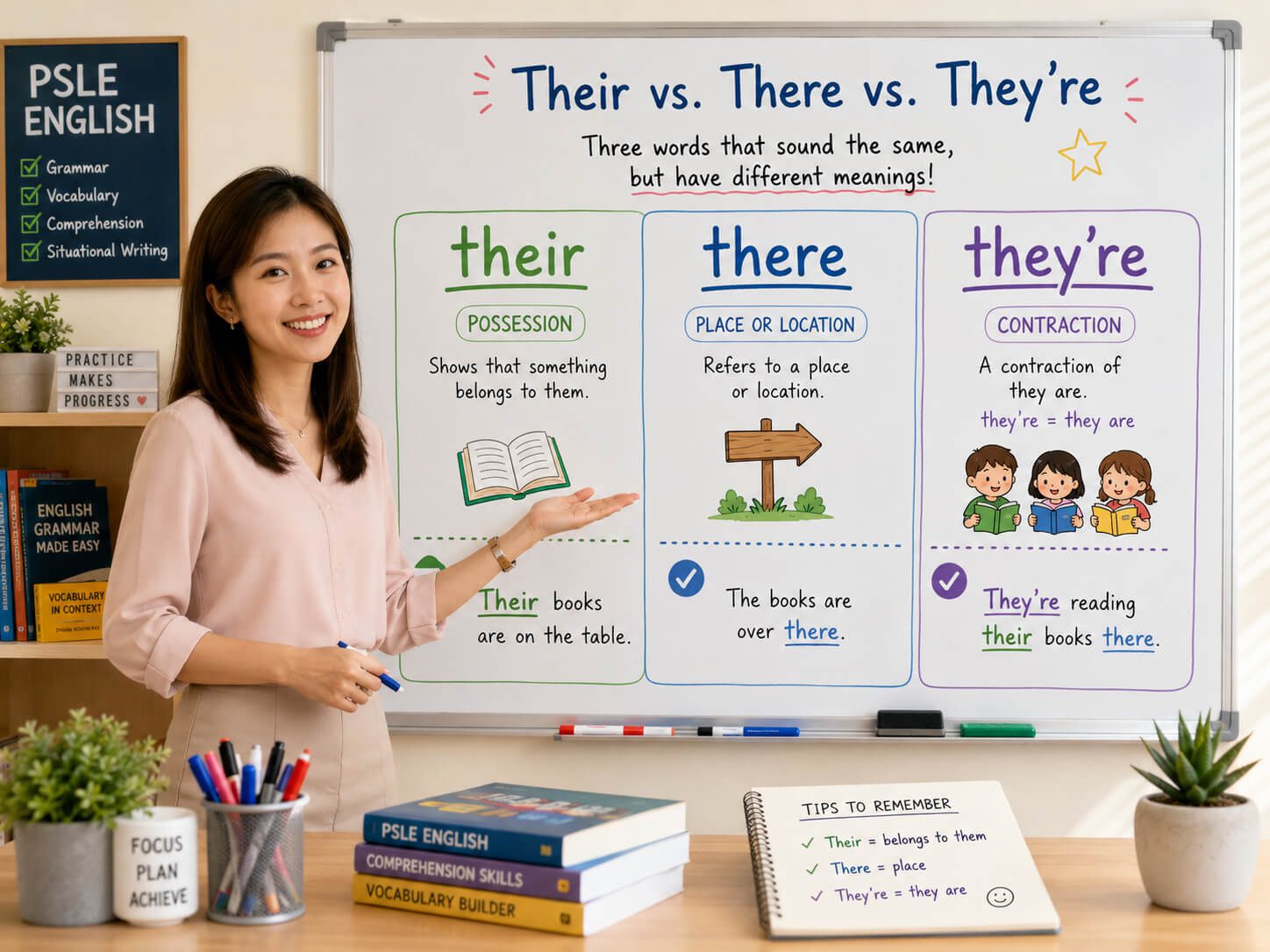
The Question / Scenario Explanation
Source: Their, there, they’re—one sentence, all 3! Beat most adults.
Here is a sentence that uses all three correctly:
They’re putting their bags over there.
Although the three words sound alike, each has a different function.
- They’re = they are
- Their = belonging to them
- There = a place or position
If students can identify the meaning needed in the sentence, choosing the correct spelling becomes much easier.
Step-by-Step Solution / Explanation
Step 1: Use “They’re” When You Mean “They Are”
They’re is a contraction.
It combines:
they + are = they’re
For example:
They’re studying for their English examination.
To check whether they’re is correct, expand it:
They are studying for their English examination.
The sentence still makes sense, so they’re is correct.
Step 2: Use “Their” to Show Possession
Their is a possessive determiner. It tells us that something belongs to or is associated with certain people.
For example:
The students packed their books.
The books belong to the students.
Another example:
They finished their homework before dinner.
The homework belongs to or is associated with them.
Step 3: Use “There” for a Place
There can refer to a place or position.
For example:
Please put your school bag over there.
A quick memory clue is that there contains the word here.
Both here and there can refer to places.
Step 4: Know That “There” Has Another Use Too
There does not always refer directly to a physical place. It can also introduce the existence of something.
For example:
There are three questions left.
There is a mistake in this sentence.
In these examples, there helps introduce what exists.
Step 5: Put All Three in One Sentence
Consider:
They’re leaving their books over there.
Break it down:
They’re = they are
Their = the books belong to them
There = the place where the books are being left
If we expand the sentence:
They are leaving their books over there.
Everything still makes sense.
Step 6: Use the Quick Three-Test Method
Whenever students are unsure, ask these questions:
- Can I replace the word with they are? Use they’re.
- Does something belong to them? Use their.
- Am I referring to a place or introducing something? Use there.
This simple test can help students distinguish their there they’re quickly during proofreading.
Key Concepts Students Must Know
- Their: Shows possession or association.
- There: Can refer to a place or introduce the existence of something.
- They’re: A contraction meaning “they are”.
- Homophones: The three words sound alike but differ in spelling and meaning.
- Context matters: Students must look at the meaning of the whole sentence rather than choosing based on sound.
- Expansion test: Replace they’re with they are. If the sentence still works, the contraction is correct.
Exam Tips / Common Mistakes
Exam Tips
- When proofreading, do not rely on how the word sounds because all three are pronounced alike.
- Expand they’re into they are to check whether it fits.
- Look for a noun after their, such as their books, their teacher or their ideas.
- Remember the here inside there when the sentence refers to a place.
- Read the entire sentence before deciding which spelling is correct.
Common Mistakes
- Writing “their going home”: The correct form is they’re going home because it means they are going home.
- Writing “put it over their”: The correct form is put it over there because it refers to a place.
- Writing “there books are new”: The correct form is their books are new because the books belong to them.
- Choosing by pronunciation: Since all three words sound alike, students must check meaning and grammar.
- Forgetting that there has more than one use: It can indicate location, but it can also introduce something, as in “There are five students.”
Parent Insight
Confusing their, there and they’re is common because children hear the same sound for all three words. The problem usually becomes clearer when students connect each spelling to a meaning rather than simply memorising the words.
Parents can practise this with a quick sentence game. Say a sentence such as, “They are putting the shoes in that place because the shoes belong to them,” and ask your child to rewrite it using the three shorter forms correctly.
The result would be:
They’re putting their shoes over there.
This allows children to practise grammar, meaning and spelling at the same time.
Conclusion
The easiest way to remember their there they’re is to give each word one clear job:
Their = possession
There = place or existence
They’re = they are
For example:
They’re putting their bags over there.
If students learn to check the meaning instead of relying on pronunciation, these three words become much easier to use accurately in PSLE English writing.
Visit our PSLE English homepage: Explore MasterEnglish
Read more PSLE English guides: Visit Our English Blog
Start here (limited slots weekly):
Free Trial: Click Here...
Enroll: Click Here...
Explore our main tuition brand approach here: Click Here...