
Introduction
This third conditional sentence question is a very common English grammar test item because it checks whether students can recognise an unreal past situation. Many students see the word “would” and guess too quickly, but once you know the structure of a third conditional sentence, the correct answer becomes much easier to choose.
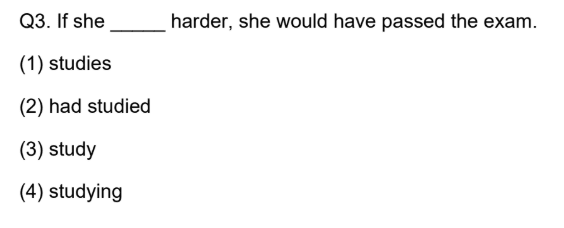
The Question / Scenario Explanation
Source: English Paper, Question 3
Question (as shown): If she _____ harder, she would have passed the exam.
Options:
(1) studies
(2) had studied
(3) study
(4) studying
Step-by-Step Solution / Explanation
Step 1: Look at the clue in the second half of the sentence
The phrase “would have passed” is the biggest clue in this question.
This tells us the sentence is talking about something unreal in the past. In other words, she did not study harder, so she did not pass the exam.
That is why this is a third conditional sentence.
Step 2: Recall the third conditional structure
The usual structure of a third conditional sentence is:
If + past perfect, would have + past participle
So the first half of the sentence should use the past perfect tense.
Step 3: Choose the correct answer
The past perfect form of study is had studied.
So the correct sentence is:
If she had studied harder, she would have passed the exam.
✅ Final Answer: (2) had studied
Step 4: Explain why the other options are wrong
(1) studies is simple present tense. It does not match the past unreal meaning of the sentence.
(3) study is the base verb form. It is not grammatically correct after if she in this sentence.
(4) studying is the -ing form, which also does not fit the required conditional structure.
Only had studied matches the grammar pattern of a third conditional sentence.
Key Concepts Students Must Know
- A third conditional sentence talks about an unreal or impossible situation in the past.
- The structure is If + past perfect, would have + past participle.
- The phrase would have is a strong clue that the sentence may be third conditional.
- Third conditional sentences usually show regret, missed chances, or imagined past results.
Exam Tips / Common Mistakes
Exam Tips
- Underline the phrase would have passed before looking at the options.
- For a third conditional sentence, check whether the first clause should be in the past perfect tense.
- Look for the full pattern instead of choosing based on one familiar word.
- Read the completed sentence aloud to see whether it sounds grammatically natural.
Common Mistakes
- Choosing studies because it looks like a normal sentence after she.
- Missing the clue would have passed and not recognising the past unreal meaning.
- Thinking any past-related verb will work, instead of using the exact past perfect form.
- Confusing a third conditional sentence with first or second conditional patterns.
Parent Insight
This third conditional sentence question shows why grammar should be taught through meaning, not just memorised rules. Many students know tense names, but they still lose marks if they cannot connect the grammar pattern to the sentence meaning. With regular guided practice, children become much more confident in grammar MCQs, cloze passages, and editing tasks.
Conclusion
This is a third conditional sentence because it describes an unreal past situation and result. The clue is would have passed, so the correct form in the first clause is had studied. Therefore, the correct answer is option (2).
Visit our PSLE English homepage: Click Here…
Read more PSLE English grammar tips and worked examples here: Click Here…
Start here (limited slots weekly):
Free Trial: Click Here…
Enroll: Click Here…
Explore our main tuition brand approach here: Click Here… .