
Introduction
Many students feel confused when they see different spellings for the same word. For example, should they write “learnt” or “learned”? Should they write “practise” or “practice”? This is where understanding British American English becomes important.
In Singapore schools, students are generally taught British English. However, they may also see American English online, in books, videos, apps, and even spell-check tools. This can make British American English differences confusing for PSLE English students.
The good news is that students do not need to panic. They just need to understand the common differences and be consistent in school writing.
The Question / Scenario Explanation
Source: Singapore British vs American English doesn’t have to be confusing
The screenshots show a teacher explaining the difference between British and American English. One example shown is:
- British English: learnt
- American English: learned
The video also highlights another common area of confusion: words such as “practice” and “practise”. In British English, “practice” is usually used as a noun, while “practise” is used as a verb. In American English, “practice” is commonly used for both the noun and the verb.
For PSLE English students, the key is to know which form is expected in school and to avoid mixing different spelling systems in the same composition.
Step-by-Step Solution / Explanation
Step 1: Understand That Both Forms May Be Correct
One of the biggest misunderstandings is thinking that one spelling is always wrong. In many cases, both forms are correct, but they belong to different English systems.
For example:
- learnt is commonly used in British English.
- learned is commonly used in American English.
This means the issue is not always about “right” or “wrong”. It is about using the correct form for the context.
Step 2: Know What Singapore Schools Usually Expect
In Singapore, students usually follow British English in school. This is why words such as “colour”, “favourite”, “centre”, and “learnt” are commonly seen in school materials.
For PSLE English writing, it is safer for students to use British English spelling consistently. This helps their writing look polished and suitable for school assessment.
Step 3: Watch Out for Common Spelling Differences
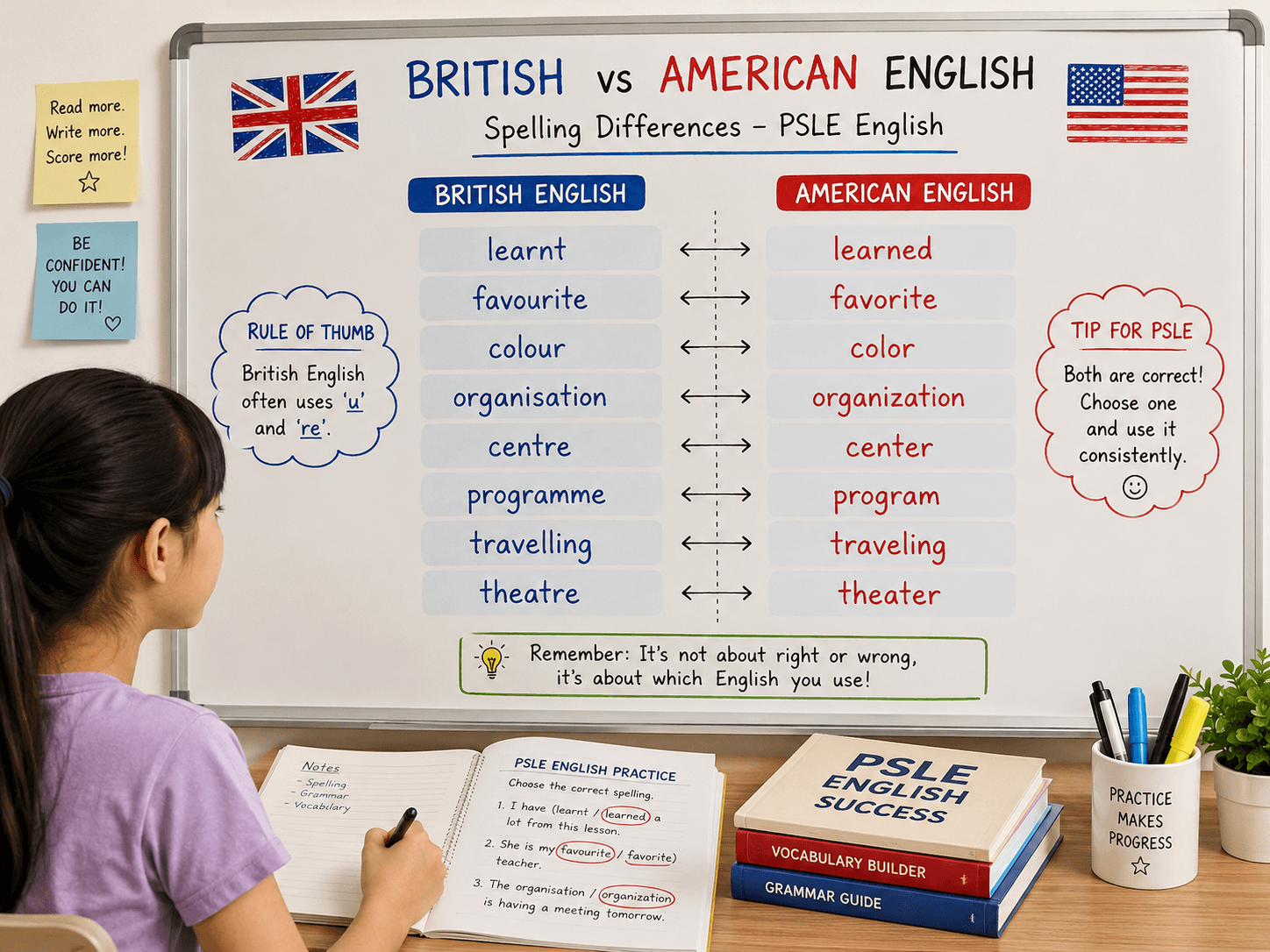
Here are some common British American English spelling differences students may notice:
- British: colour | American: color
- British: favourite | American: favorite
- British: centre | American: center
- British: learnt | American: learned
- British: travelling | American: traveling
Students should be aware of these differences so that they do not get confused when reading different materials.
Step 4: Understand “Practice” and “Practise”
This is a very common PSLE English confusion.
In British English:
- practice is usually a noun.
- practise is usually a verb.
Examples:
- Noun: I went for piano practice.
- Verb: I need to practise my oral reading.
In American English, “practice” is commonly used for both noun and verb. However, for school writing in Singapore, students should learn the British English distinction.
Step 5: Stay Consistent in Compositions
One important exam strategy is consistency. Students should avoid mixing British and American spellings in the same piece of writing.
For example, avoid writing:
- “My favourite color is blue.”
This mixes British “favourite” with American “color”. A more consistent British English version would be:
- “My favourite colour is blue.”
Consistency makes the composition cleaner and easier for teachers to mark.
Key Concepts Students Must Know
- British and American English are both accepted forms of English: They may differ in spelling, grammar, and word choice.
- Singapore schools usually follow British English: This is why students should be familiar with British spelling.
- Consistency matters: Students should not mix British and American spelling in one composition.
- Some words change by spelling: Examples include colour/color, centre/center, and learnt/learned.
- Some words change by grammar use: In British English, practice is usually a noun and practise is usually a verb.
Exam Tips / Common Mistakes
Exam Tips
- Use British English spelling for school compositions unless your teacher says otherwise.
- Build a personal spelling list of common British English words.
- Check your writing for consistency before submitting.
- Be careful with spell-check tools, as some may use American English settings.
- Remember that “practice” and “practise” have different uses in British English.
Common Mistakes
- Mixing British and American spelling in the same sentence.
- Using “practice” as a verb when British English requires “practise”.
- Assuming American spelling is always wrong.
- Changing spelling style halfway through a composition.
- Relying fully on autocorrect without checking the school standard.
A useful way to remember British American English differences is to keep a short spelling notebook. Students can record words that often confuse them and review the list before writing practice.
Parent Insight
Parents may notice that their child reads materials from many sources, including YouTube captions, online worksheets, international books, and apps. Some of these use American English, while Singapore schools usually expect British English.
This is why a child may spell a word differently even when they are not being careless. They may have seen both versions before.
At home, parents can help by asking simple questions such as:
- “Which spelling does your school usually use?”
- “Is this British or American spelling?”
- “Are you using the same style throughout your composition?”
These small checks can help students become more aware of spelling choices and improve their writing accuracy.
Conclusion
British American English differences do not have to be confusing. Students simply need to understand that both systems exist, but school writing in Singapore usually follows British English.
For PSLE English, the safest approach is to use British spelling consistently and to check commonly confused words such as learnt/learned, colour/color, centre/center, and practice/practise.
With regular exposure and careful checking, students can write with better accuracy and confidence.
Visit our homepage: Click Here…
Read more on our blog: Click Here…
Start here (limited slots weekly):
Free Trial: Click Here…
Enroll: Click Here…
Explore our main tuition brand approach here: Click Here… .