
Introduction
This future perfect tense question is a very useful grammar example because it tests whether students can recognise an action that will be completed by a specific time in the future. Many students get confused when they see time markers like “by next year”, but once you understand how the future perfect tense works, the correct answer becomes much easier to choose.
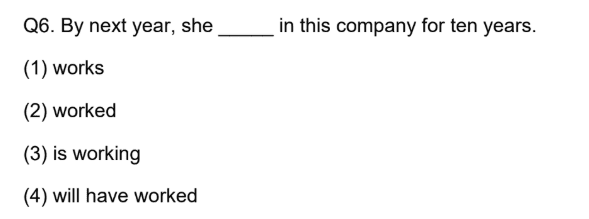
The Question / Scenario Explanation
Source: English Paper, Question 4
Question (as shown): By next year, she _____ in this company for ten years.
Options:
(1) works
(2) worked
(3) is working
(4) will have worked
Step-by-Step Solution / Explanation
Step 1: Look carefully at the time marker
The phrase “By next year” is the biggest clue in this sentence. It points to a time in the future and asks us to think about something that will already be completed by then.
That is why this question is testing the future perfect tense.
Step 2: Match the tense to the meaning
The sentence means that when next year arrives, her total time in the company will reach ten years.
So we need a tense that shows:
- the action is connected to the future
- the period of time will be completed by that future point
The correct tense for this meaning is future perfect tense.
Step 3: Choose the correct answer
The correct structure is:
will have + past participle
So the correct answer is:
(4) will have worked
The full sentence becomes:
By next year, she will have worked in this company for ten years.
✅ Final Answer: will have worked
Step 4: Understand why the other options are wrong
(1) works is simple present tense. It is used for habits, routines, or general truths, but it does not fit the future time marker “by next year”.
(2) worked is simple past tense. It talks about a finished action in the past, so it does not match the future meaning of the sentence.
(3) is working is present continuous tense. It shows an action happening now or around now, not something that will be completed by a future time.
Only (4) will have worked correctly matches the meaning of completion by a future point, which is why it is the right future perfect tense answer.
Key Concepts Students Must Know
- Future perfect tense is used for an action that will be completed before or by a certain time in the future.
- The usual structure is will have + past participle.
- Common clues include phrases like by next year, by then, by tomorrow, and by the time.
- When duration is mentioned, such as for ten years, students should check whether the sentence is pointing to a completed period in the future.
Exam Tips / Common Mistakes
Exam Tips
- Underline time markers like by next year before looking at the options.
- Ask yourself whether the action is happening now, happened before, or will be completed in the future.
- For future perfect tense questions, look out for the pattern will have + past participle.
- Read the full sentence again after choosing your answer to check whether it sounds natural and logical.
Common Mistakes
- Choosing is working because the sentence talks about a continuing job, while ignoring the future time marker.
- Choosing worked just because “ten years” sounds long and historical.
- Missing the word by, which often signals completion before a future time.
- Forgetting that future perfect tense is about an action that will already be completed by a future point.
Parent Insight
This future perfect tense question shows why grammar practice should go beyond memorising tense names. Students need to connect the tense to the meaning of the sentence. When children learn to spot time markers and understand what each tense is used for, they become much more accurate in grammar MCQs and close passage questions.
Conclusion
This sentence uses the future perfect tense because it describes something that will be completed by a future time. The clue is “by next year”, and the correct form is will have worked. So the correct answer is option (4).
Visit our PSLE English homepage: Click Here…
Read more PSLE English grammar tips and worked examples here: Click Here…
Start here (limited slots weekly):
Free Trial: Click Here…
Enroll: Click Here…
Explore our main tuition brand approach here: Click Here… .