
Introduction
Vocabulary questions become much easier when students use context clues and choose the most natural phrase. This living in despair question is a common PSLE-style test where the correct answer matches the situation and emotional tone of the sentence.
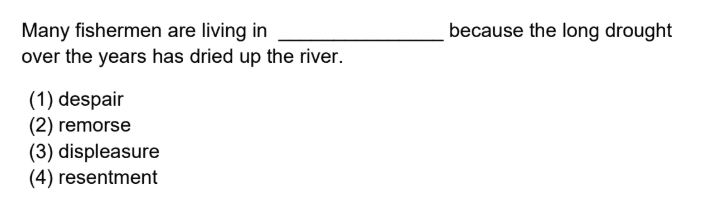
The Question / Scenario Explanation
Source: English Paper, Question 9
Many fishermen are living in __________ because the long drought over the years has dried up the river.
Options:
- despair ✅
- remorse
- displeasure
- resentment
Step-by-Step Solution / Explanation
Step 1: Identify the cause in the sentence
The sentence explains a serious problem:
- long drought over the years
- river dried up
This affects fishermen’s livelihood and income, creating a hopeless situation.
Step 2: Choose the word that matches the emotional meaning
Living in despair means living with deep sadness and hopelessness because the situation feels very difficult and may not improve soon.
Step 3: Check if the phrase is natural in English
“Living in despair” is a natural and commonly used phrase.
Correct sentence:
Many fishermen are living in despair because the long drought…
Correct Answer: Option (1) despair ✅
Key Concepts Students Must Know
- living in despair = living with hopelessness and deep sadness
- Context clues that point to despair:
- long-term problem (“over the years”)
- loss of livelihood (river dried up → fishermen cannot work)
- PSLE vocabulary often tests emotional tone (hopeless, angry, guilty, unhappy)
Exam Tips / Common Mistakes
Exam Tips
- Ask: “What emotion would a person feel in this situation?”
- If the problem is long-term and serious, words like living in despair often fit best
- Choose the option that matches both meaning and natural English usage
Common Mistakes
- Choosing remorse (remorse is guilt after doing something wrong—doesn’t fit drought)
- Choosing displeasure (too mild; drought destroying livelihood is much more serious)
- Choosing resentment (anger towards someone; the sentence shows hopelessness, not blame)
Parent Insight
Questions like living in despair train students to read carefully and infer emotions from context—an important comprehension skill too. With guided vocabulary practice, students learn to:
- distinguish similar “negative emotion” words
- match tone correctly (mild vs serious)
- reduce guessing in PSLE vocabulary MCQ
Conclusion
The long drought has dried up the river, affecting the fishermen’s ability to earn a living. That situation creates deep hopelessness, so living in despair is the best and most natural answer. That’s why Option (1) “despair” is correct.
Learn more about our PSLE English programme at: Click Here…
For more vocabulary practice posts like living in despair, visit our blog: Click Here…
Start here:
Free Trial: Click Here…
Enroll: Click Here…
Explore our main tuition brand approach at: Click Here…