
Introduction
Many students say, “Teacher, can I go to the toilet?” in class. While people may understand the meaning, this sentence is not the most accurate when asking for permission. This is where may can grammar becomes important for PSLE English students.
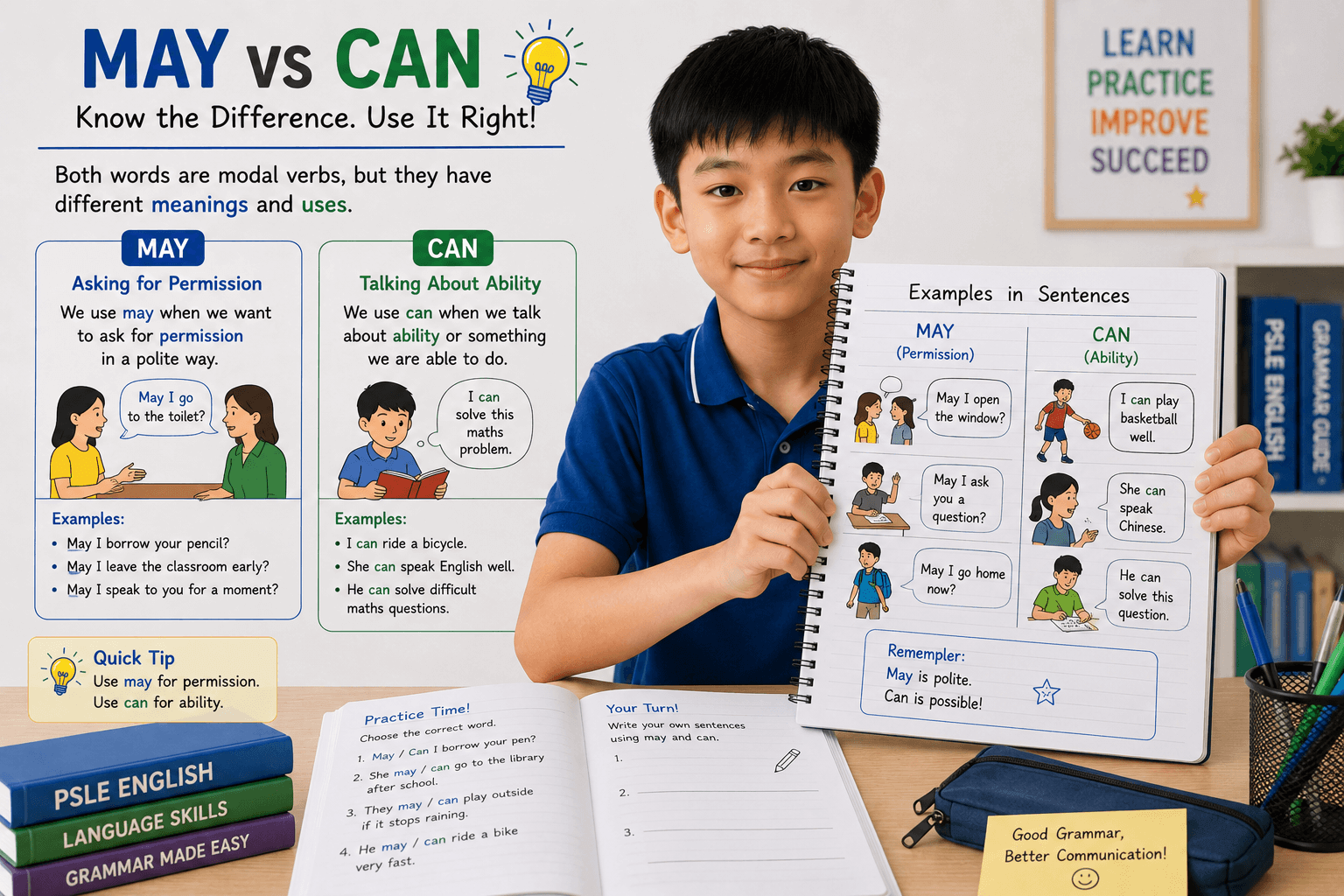
In English, “can” and “may” are both modal verbs, but they are used differently. “Can” is usually used to talk about ability, while “may” is used to ask for permission politely.
Understanding may can grammar helps students speak more politely, write more accurately, and avoid common grammar mistakes in school.
The Question / Scenario Explanation
Source: “Excuse me, may I use the washroom?”
The screenshots show a teacher explaining a common classroom sentence:
“Teacher, can I go to the toilet?”
The video explains that “can” is usually used when we are talking about whether someone is physically able to do something.
For example:
- I can play video games.
- I can write neatly.
- I can run quickly.
However, when a student wants to ask for permission, the better sentence is:
“Excuse me, may I use the washroom?”
This sounds more polite and more suitable in a school setting.
Step-by-Step Solution / Explanation
Step 1: Understand What “Can” Means
The word “can” is usually used to show ability. It tells us that someone is able to do something.
Examples:
- I can swim.
- She can solve the question.
- They can speak English clearly.
In these examples, “can” is about ability, not permission.
Step 2: Understand What “May” Means
The word “may” is often used to ask for permission in a polite way.
Examples:
- May I come in?
- May I borrow your pencil?
- May I use the washroom?
These sentences are suitable when speaking to teachers, adults, or people in formal situations.
Step 3: Compare the Two Sentences
Let us compare these two sentences:
- Can I go to the toilet?
- May I use the washroom?
“Can I go to the toilet?” can sound like the student is asking whether they are physically able to go.
“May I use the washroom?” clearly asks for permission and sounds more polite.
This is the main idea behind may can grammar.
Step 4: Use Polite Phrasing
A good school sentence should be polite and clear.
Instead of saying:
“Teacher, can I go toilet?”
A better sentence is:
“Excuse me, may I use the washroom?”
This sentence is more complete because it includes:
- “Excuse me” to get attention politely
- “may I” to ask for permission
- “use the washroom” as a polite phrase
Step 5: Know When “Can” Is Still Acceptable
In casual speaking, many people use “can” when asking for permission. For example, “Can I borrow this?” is commonly heard.
However, for school, formal writing, and good spoken English, “may” is the better choice when asking permission.
Students should understand both, but use the more accurate form when the situation is formal.
Step 6: Apply It in Daily School Situations
Students can use “may” in many classroom situations:
- May I ask a question?
- May I sharpen my pencil?
- May I drink some water?
- May I leave the classroom?
- May I use the washroom?
Practising these sentences helps students build better speaking habits.
Key Concepts Students Must Know
- “Can” shows ability: It tells us that someone is able to do something.
- “May” asks for permission: It is more polite and suitable for formal situations.
- Context matters: Casual speech and school English may not always use the same phrasing.
- Politeness is important: “Excuse me, may I…” sounds respectful when speaking to teachers.
- Grammar affects communication: Choosing the right word helps students sound clearer and more confident.
Exam Tips / Common Mistakes
Exam Tips
- Use “can” when the sentence is about ability.
- Use “may” when the sentence is asking for permission.
- In formal writing, choose the more polite and accurate option.
- Read the whole sentence before choosing the modal verb.
- Check whether the speaker is asking to be allowed to do something.
Common Mistakes
- Using “can” for every request.
- Forgetting that “may” sounds more polite when asking permission.
- Saying incomplete sentences such as “Can go toilet?”
- Using casual speech in formal writing.
- Not recognising the difference between ability and permission.
A useful way to remember may can grammar is this: use “can” when you are talking about ability, and use “may” when you are asking for permission.
Parent Insight
Parents may hear children using “can” in many everyday requests. This is common in casual conversation, but children should also learn the more polite and grammatically accurate form for school.
At home, parents can encourage children to practise sentences such as:
- May I have some water?
- May I use your phone?
- May I ask you something?
- May I leave the table?
This builds confidence in polite communication. It also helps children become more aware of tone, grammar, and context.
Conclusion
May can grammar is simple once students understand the difference. “Can” is mainly used for ability, while “may” is used to ask for permission politely.
So instead of saying, “Teacher, can I go to the toilet?”, a better sentence is:
“Excuse me, may I use the washroom?”
With regular practice, PSLE English students can speak and write more accurately, politely, and confidently.
Visit our homepage: Click Here…
Read more on our blog: Click Here…
Start here (limited slots weekly):
Free Trial: Click Here…
Enroll: Click Here…
Explore our main tuition brand approach here: Click Here… .