
Introduction
Some PSLE grammar questions test sentence structure more than tense. This paying little attention question looks simple, but many students choose a verb form that breaks the sentence. Once you spot the correct structure, the answer becomes very clear.
The Question / Scenario Explanation
Source: English Paper, Question 11
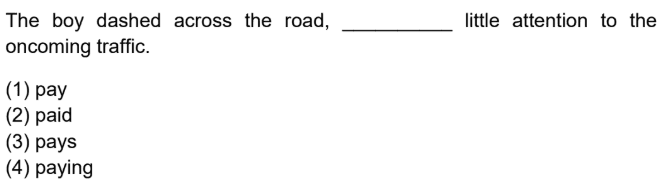
The boy dashed across the road, ________ little attention to the oncoming traffic.
Options:
- pay
- paid
- pays
- paying ✅
Step-by-Step Solution / Explanation
Step 1: Identify the main action (main clause)
Main clause: “The boy dashed across the road,”
This is the main action in the past tense.
Step 2: Recognise what comes after the comma
After the comma, we add extra information describing how he dashed.
This is done using a present participle (-ing) phrase.
So we need: paying little attention…
Step 3: Check if the phrase is natural in English
“Paying little attention” is a common phrase meaning “not noticing” or “not caring about” something important.
Correct sentence:
The boy dashed across the road, paying little attention to the oncoming traffic.
Correct Answer: Option (4) paying ✅
Key Concepts Students Must Know
- paying little attention is a participle phrase that describes the action
- Structure: Main clause + comma + -ing phrase
- He ran out, forgetting his bag.
- She walked away, crying softly.
- This -ing phrase shows what was happening at the same time
Exam Tips / Common Mistakes
Exam Tips
- If there is a comma after the first clause, check if the second part is describing the action
- When describing how something happened, the -ing form is often correct
- Read the sentence aloud: “dashed…, paying…” sounds natural and complete
Common Mistakes
- Choosing paid: would need a full new clause or connector (and it doesn’t describe the action smoothly)
- Choosing pay or pays: breaks grammar because it becomes an incomplete or incorrect clause after the comma
- Forgetting that the -ing phrase must refer to the subject (“the boy”), not someone else
Parent Insight
This type of question appears often because it tests sentence variety and correct grammar structures. When students master patterns like paying little attention, they improve not only MCQ accuracy but also their writing skills—especially for composition, where varied sentence structures earn better language marks.
Conclusion
The sentence needs a descriptive -ing phrase after the comma to show what the boy was doing while he dashed across the road. That’s why paying little attention is correct, and Option (4) “paying” is the best answer.
Learn more about our PSLE English programme at: Click Here…
For more vocabulary practice posts like paying little attention, visit our blog: Click Here…
Start here:
Free Trial: Click Here…
Enroll: Click Here…
Explore our main tuition brand approach at: Click Here… .