
Introduction
Many students mix up your vs you’re because the two words sound the same when spoken. However, they do not mean the same thing at all. This small grammar mistake can make a sentence look careless in compositions, editing tasks, and daily writing.
For PSLE English students, understanding your vs you’re is important because both words are common and often tested. The good news is that the difference is actually very simple once students know what each word does.
In this lesson, we will break down the meaning of each word, show how to check which one is correct, and explain how to avoid this mistake in school writing.
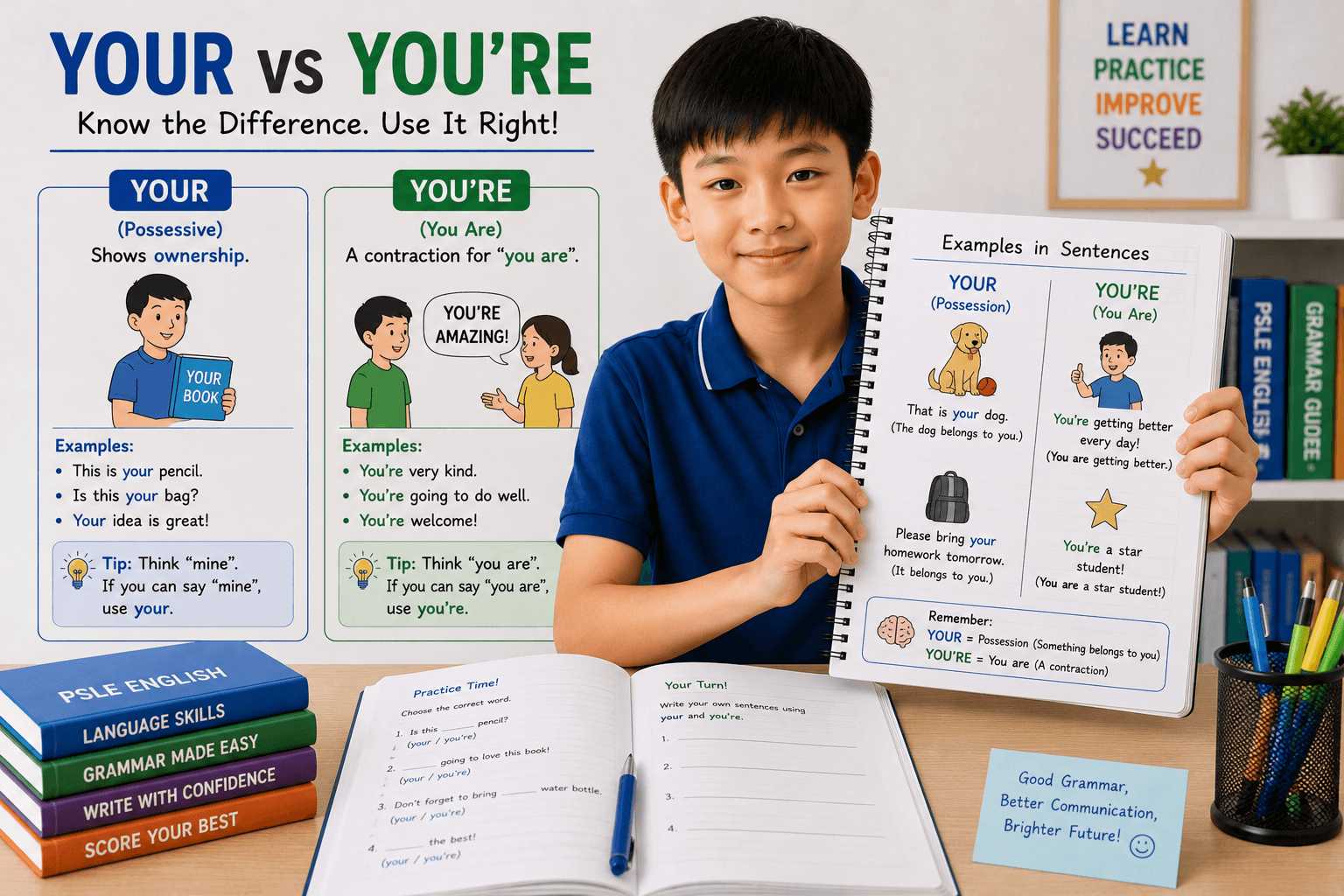
The Question / Scenario Explanation
Source: “Your” vs “You’re” — are you sure you know the difference?
The screenshots show a teacher explaining that your and you’re are not the same word.
The key ideas from the video are:
- Your means something belongs to you.
- You’re is short for you are.
- A quick way to check is to replace you’re with you are. If the sentence still makes sense, then you’re is correct.
Examples shown in the explanation include:
- Your food
- Your book
- Your turn
- You’re late
The video also gives a quiz-style sentence:
Which is correct?
Your teacher is here.
or
You’re teacher is here.
The correct answer is Your teacher is here. This is because the teacher belongs to “you” in the sense of being your teacher, so we need the possessive word your.
Step-by-Step Solution / Explanation
Step 1: Understand What “Your” Means
Your is a possessive word. It shows that something belongs to you or is connected to you.
Examples:
- Your pencil is on the table.
- I like your handwriting.
- Your bag is very heavy.
- Is this your worksheet?
In all these examples, your is used before a noun such as pencil, handwriting, bag, or worksheet.
Step 2: Understand What “You’re” Means
You’re is a contraction. It is the short form of you are.
Examples:
- You’re very kind.
- You’re early today.
- You’re doing well.
- I think you’re correct.
If we expand the contraction, the sentences become:
- You are very kind.
- You are early today.
- You are doing well.
- I think you are correct.
This shows clearly that you’re means you are.
Step 3: Use the “You Are” Test
The easiest way to solve your vs you’re questions is to use the replacement trick.
Replace you’re with you are. If the sentence still makes sense, then you’re is correct.
Example 1:
You’re late.
Replace it:
You are late.
This makes sense, so you’re is correct.
Example 2:
Your teacher is here.
If we replace it with you are, we get:
You are teacher is here.
This does not make sense, so you’re is wrong here. The correct word is your.
Step 4: Know the Grammar Difference
This grammar point becomes easier when students know the roles of the two words:
- Your is used before a noun because it shows possession.
- You’re is used as part of a verb phrase because it means you are.
For example:
- Your friend is waiting outside. → friend is a noun, so your is correct.
- You’re friendly. → friendly describes a person, and you’re means you are.
Step 5: Compare Common Examples
Here are some correct sentence pairs:
- Your answer is correct. / You’re correct.
- Your shoes are wet. / You’re getting wet.
- Your homework is neat. / You’re very hardworking.
- Your class starts now. / You’re in the right classroom.
These examples help students see how the meaning changes depending on the word chosen.
Step 6: Avoid Common Wrong Sentences
Students often make mistakes like:
- You’re bag is on the chair. ✘
- Your very smart. ✘
- I think your right. ✘
Correct versions:
- Your bag is on the chair. ✔
- You’re very smart. ✔
- I think you’re right. ✔
This is why understanding your vs you’re is so useful in editing and writing tasks.
Key Concepts Students Must Know
- Your shows possession: it tells us something belongs to you.
- You’re is the short form of you are.
- Your is usually followed by a noun, such as book, teacher, or turn.
- You’re can be checked by replacing it with you are.
- Even though the two words sound the same, they have different meanings and grammar functions.
Exam Tips / Common Mistakes
Exam Tips
- Use the you are test whenever you feel unsure.
- Look at the word that comes after the blank. If it is a noun, your is often needed.
- Read the full sentence, not just the missing word.
- In editing tasks, check every apostrophe carefully.
- In composition writing, leave a few moments at the end to scan for grammar mistakes like your vs you’re.
Common Mistakes
- Writing your when the sentence actually means you are.
- Writing you’re before a noun, such as “you’re pencil”.
- Ignoring the apostrophe in you’re.
- Choosing the word based only on sound instead of meaning.
- Rushing through editing tasks without checking grammar carefully.
A useful exam strategy is to slow down whenever you see sound-alike words. In PSLE English, correct grammar often depends on meaning, not pronunciation.
Parent Insight
Parents may notice that children mix up your and you’re even when they know the rule. This usually happens because both words sound the same in speech, so students write what they hear instead of thinking about the meaning.
A simple way to help at home is to ask your child to explain the sentence out loud:
- Does the sentence mean something belongs to you?
- Or does it mean you are something?
Parents can also practise short examples such as:
- Your pencil is missing.
- You’re very careful.
- Your friend is calling you.
- You’re making good progress.
This helps children build the habit of checking meaning before writing.
Conclusion
Your vs you’re becomes much easier once students remember one simple difference: your shows possession, while you’re means you are.
If students are unsure, they can use the quick test: replace you’re with you are. If the sentence still makes sense, then you’re is correct. If not, they probably need your.
With regular practice, PSLE English students can avoid this very common grammar mistake and write more clearly and confidently.
Visit our homepage: Click Here…
Read more on our blog: Click Here…
Start here (limited slots weekly):
Free Trial: Click Here…
Enroll: Click Here…
Explore our main tuition brand approach here: Click Here… .